


Check the user-facing endpoint, not just the host
E4S records availability and HTTP response behavior for registered websites. Redirects, final response, check time, and status history help operators distinguish an intermittent outage from a stable change. Registered HTTPS assets also provide certificate validity and expiry context.
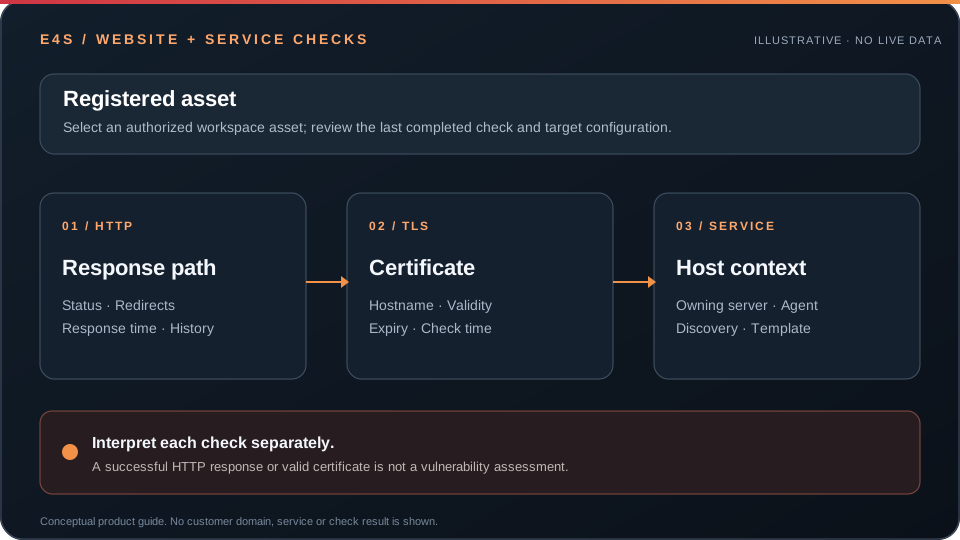
Illustrative panels; no live website or customer data is shown.
What a successful check does not prove
An HTTP 200 can still lead to the wrong page, and a valid certificate does not establish that application dependencies are secure. Review the exact target and the last completed result. See website status and SSL for a step-by-step investigation.
Monitor the URL your customer actually uses
Register the public HTTPS endpoint and identify the expected redirect and response behavior. A basic homepage check can reveal a connection failure, redirect loop or unexpected status, while certificate information helps prevent an avoidable TLS interruption. The target must be an authorized public site; private-network targets are not accepted for ordinary customer website checks.
Investigate beyond one status code
Review the final URL, check time, response duration and recent history. A 200 response could still be a maintenance page, login wall or application error rendered as success. Verify business-critical steps through application testing or agreed synthetic checks where available rather than assuming a single GET covers the whole checkout or registration journey.
What if the site is reachable from one location but not another? Compare check evidence with DNS, provider and user reports before deciding the failure boundary. Read the website and SSL guide or request a monitoring assessment.